Product Reviews
"...scintillating..."
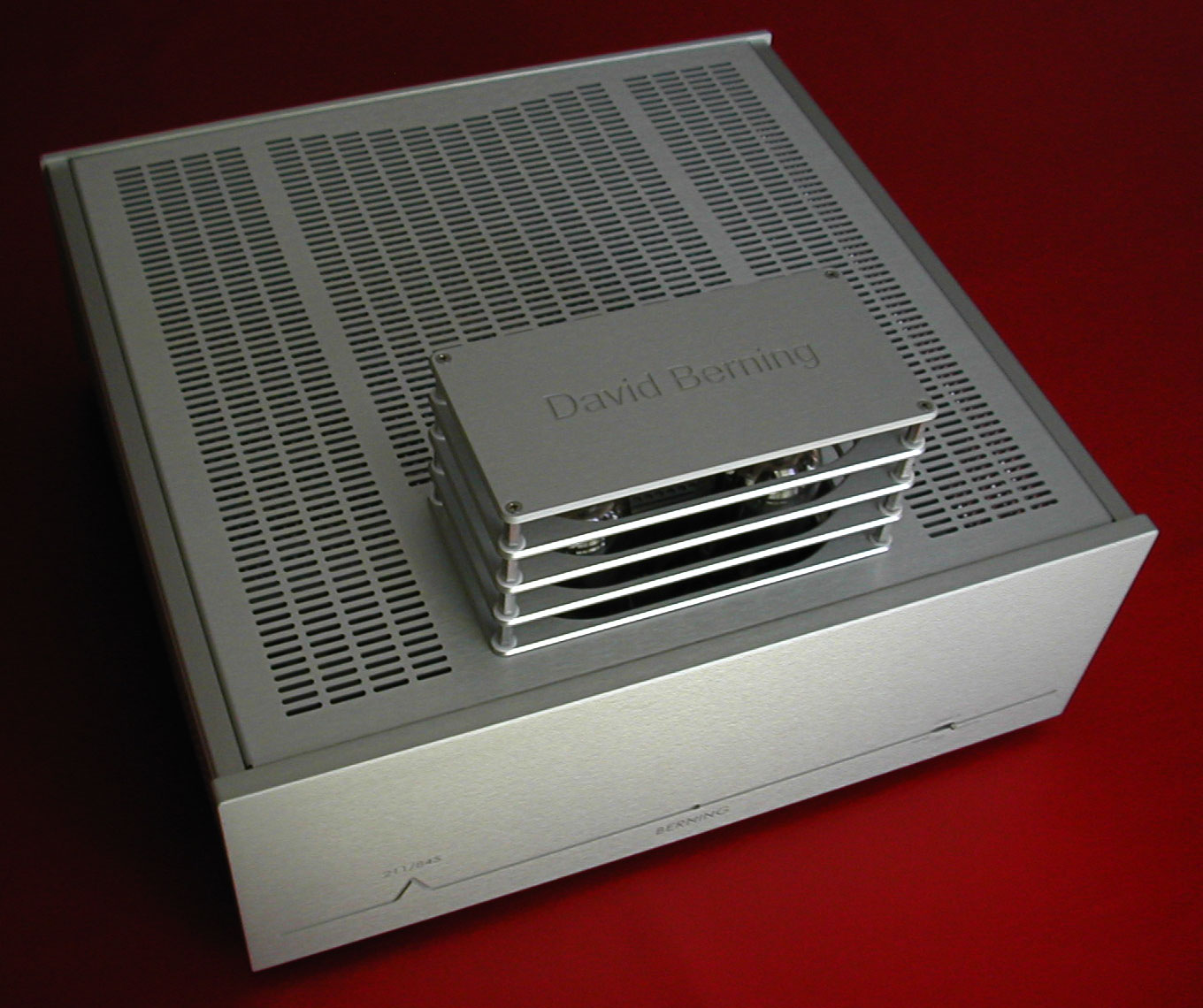
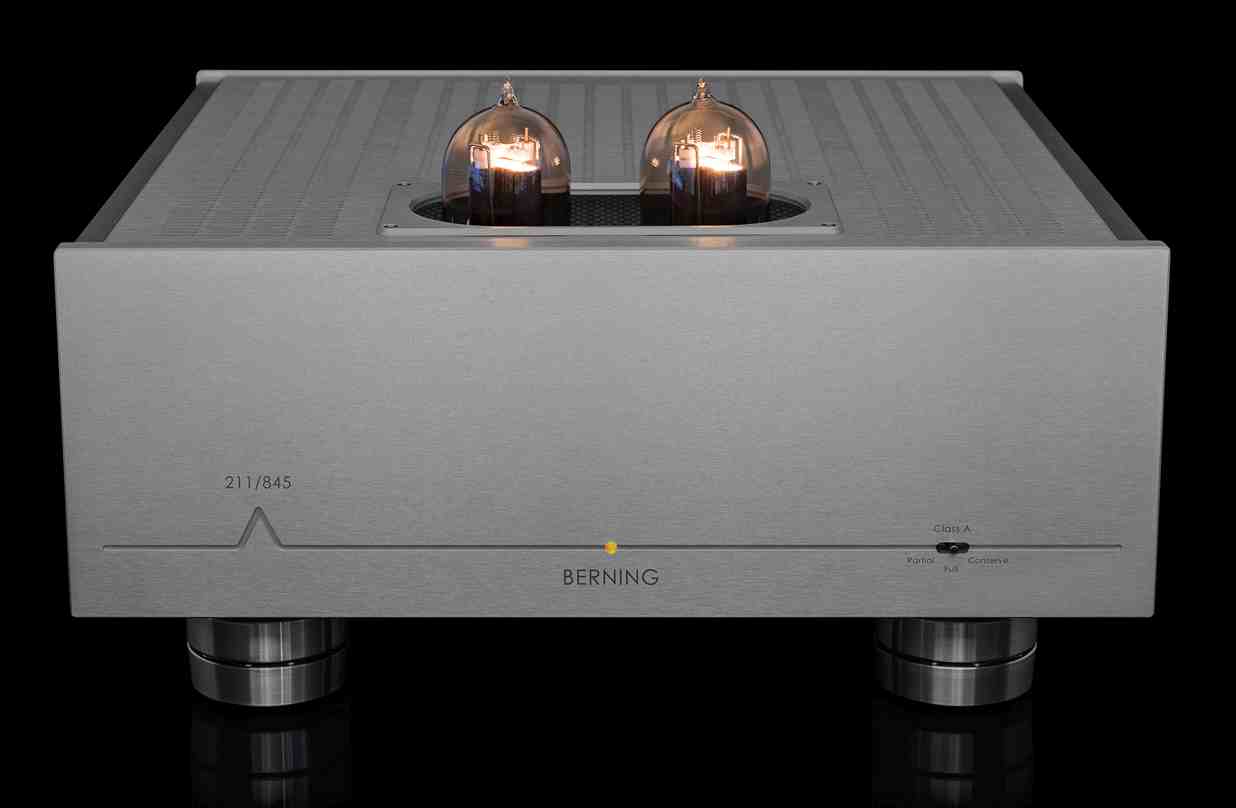
Robert Harley / the abso!ute sound reviews the Berning 211 / 845 Mono Amplifier
 | | |
"I won’t mince words: The Berning 211/845 is the most beautiful sounding amplifier I’ve ever heard."
"Just when I thought I’d heard virtually the entire spectrum of power amplifiers, along comes the 211/845 from The David Berning Company. With 60W of pure Class A push-pull tube power, no output transformer, and zero global feedback, the 211/845 certainly occupies a little-explored corner of high-end audio. But I’m glad that I gave this offbeat amplifier a listen, because it opened my ears to the starling qualities of vacuum tube power when freed from the sonic bottleneck that is the output transformer. No other amplifier is built like the 211/845—and no other amplifier sounds quite like the 211/845."
"The 211/845’s stunning sense of realism isn’t just the result of its transparency and naturalness of tone color, but is heightened by the amplifier’s extraordinary soundstage dimensionality. This dimensionality is manifested as remarkable separation of instruments from each other, tremendous depth, expansive space, and the impression that the reverberation is distinct from the instrumental images rather than being fused to them. The Berning’s “see-through” quality amplified this spatial rendering, allowing me to hear with vivid clarity very fine instrumental lines at the back of the hall."
"...an amplifier like no other."
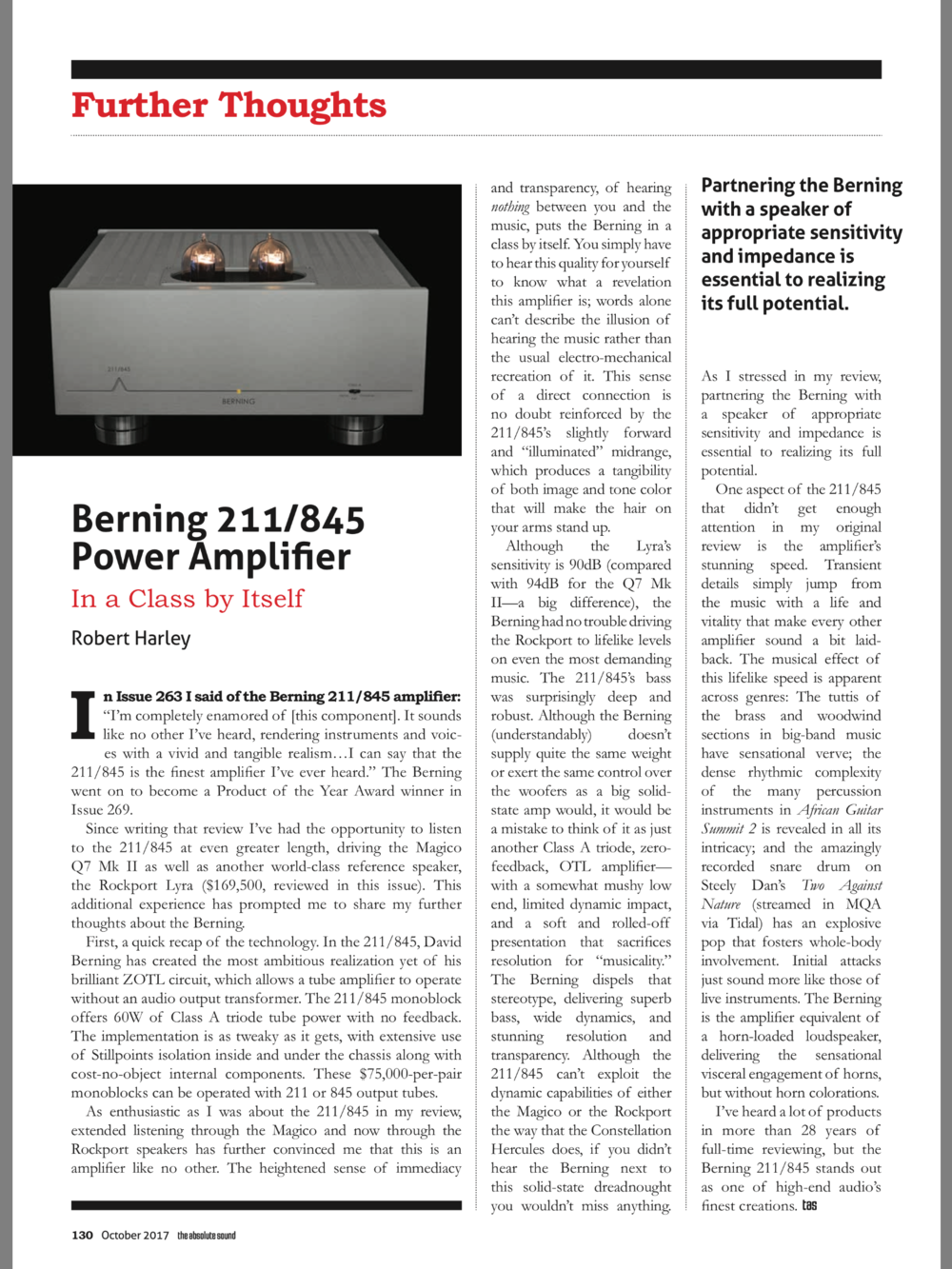
Robert Harley / the abso!ute sound / Further Thoughts on Berning 211 / 845 Mono Amplifier
"The heightened sense of immediacy and transparency, of hearing nothing between you and the music, puts the Berning in a class by itself. You simply have to hear this quality for yourself to know what a revelation this amplifier is; words alone can't describe the illusion of hearing the music rather than the usual electro-mechanical recreation of it."
"Harmonically sophisticated"
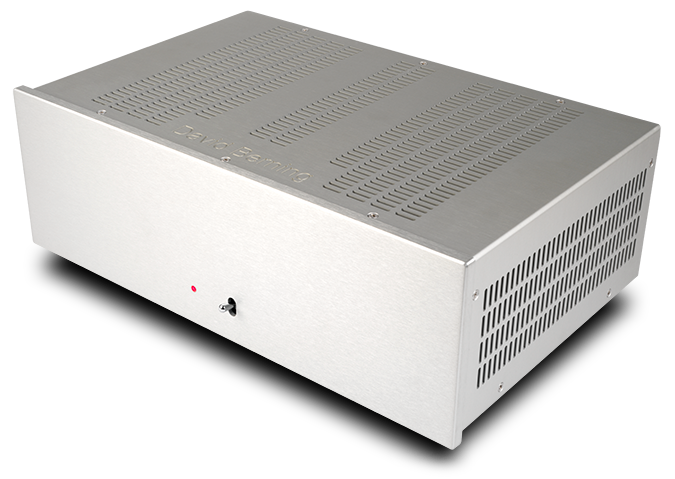
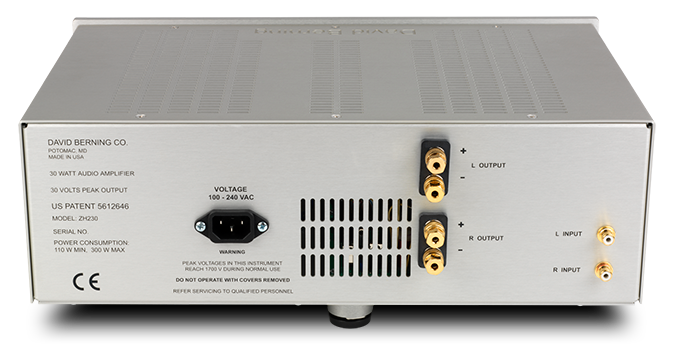
Soundstage Ultra reviews the Berning ZH-230 Stereo Amplifier
"Many manufacturers claim that their products are 'innovative,' but few merit that description more than the amplifiers designed by David Berning. ...
"When the Berning arrived, I was reviewing a pair of speakers that sounded decent. The ZH-230 transformed them into speakers that sounded seriously good. The bass was now supercharged, with considerably more extension and weight. I ended up swearing a lot as I put this amp through its paces, saying things like "I can't believe this amp sounds this @#%&* good! ...
The ZH-230 "...delivered power right now. That speed made it the most effortlessly dynamic-sounding amplifier I've ever heard, and it seemed much more powerful than its rated output. Heck, it sounded more dynamic than my Audio Research VS115, which puts out 115Wpc to the Berning's 30Wpc. And it wasn't just the ZH-230's ability to play loudly -- the microdynamic changes within musical passages that constitute a musician's phrasing were somehow more clearly defined than with most other amps I've heard. There was a sense of unlimited dynamic reserve -- as if every other amp I've heard has been dynamically compressed. But I don't think those amps were actually compressed -- I think they were slow. I can't emphasize enough how the ZH-230's dynamic agility enhanced the music played through it. And I don't mean just a few orchestral blockbusters; it applied equally to every album I listened to. Dynamics are a huge part of music, and doing them better makes the music sound better. ...
"And as the musicians' musical lines ebbed and flowed, the Berning's microdynamic capabilities made these continuous variations in their instruments' volumes very easy to follow. When an amplifier reproduces the most fleeting volume changes, you hear more of the performers' intent. That's what high-end audio is all about....
"...the ZH-230 realistically presented tonality in time and space -- instruments sounded right. ... The ZH-230's instantaneous dynamics benefited ... lightning-fast dynamic swings. I seem to be saying that a lot. ...
"I was totally smitten by the David Berning Company's ZH-230. It solves some of the significant drawbacks of tube amplifiers -- short tube life, heavy weight, limited bandwidth -- while retaining the tonal luminosity, detail, and smoothness for which tubes are prized. Its ability to provide almost instantaneous power made it sound more powerful than its rated output. ...
"As a reviewer, I get to audition a fair number of amplifiers ... the Berning ZH-230 is the best I've ever heard. ... what counts is that the ZH-230 made music sound right. For me, that meant it was more fun to listen to music with the Berning ... David Berning's ZH-230 has made it very hard for me to listen to other amplifiers."
The Absolute Sound Magazine TAS210, by Dick Olsher
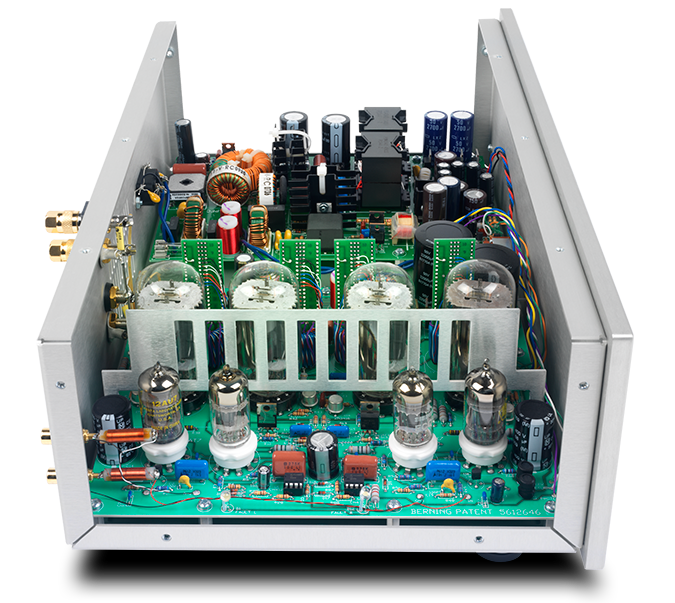
"The overall presentation possessed a refreshingly low-distortion signature -- no tube brightness or glare to complain about. Harmonic colors shone vividly while textures were consistently sweet sounding, smooth, and totally grunge- and grain-free. The harmonic envelope of a solo instrument ebbed and flowed in a relaxed, effortless manner, with richness of tone. By extension there was plenty of low-level detail to behold. But it was all very discreet, without the cheap trick of etching treble transients. "...the ZOTL is in reality an emulation circuit for an ideal output transformer. It matches impedance just like a transformer, and it is a two-way communication between tubes and speaker as is a conventional transformer. The beauty of it is that the ZOTL does not suffer from the frequency-dependence issues of a transformer... the two-way communication is a critical design feature. This is the thing that separates the ZOTL from a hybrid amplifier. The ZOTL should not be considered a tube amp followed by some other kind of output buffer -- it is not. By having the two-way communication, the speaker is fully controlled by the output characteristics of the tubes, and that includes all-important damping. This is not the case with the hybrid amplifier that is simply tubes with an output buffer. "This is one of the few power amps I can easily carry under my arm. That can be explained not only by the lack of a conventional output transformer but also by the absence of a power transformer. There's no heavy iron here. The power supply is a switching type and incorporates a five-stage power-line filter and surge suppressor. The amplification circuitry is fully balanced... Since the ZH-230 is auto-biasing, these tubes may be changed without having to worry about manual bias-calibration... Since the idle-plate dissipation of the power tubes is only 7.5W and their heaters are operated below the rated voltage, their expected lifetime, according to Berning, is 10,000 hours. "...a new product introduction from the creative mind of David Berning is an event, a happening if you will. His designs are far from being yet another twist on a 1950s circuit, which to be perfectly honest is what most of tube audio is all about nowadays... It represents David Berning's severing of the Gordian Knot that is a conventional audio output transformer..." "The other attribute that set the Berning apart from the crowd was its immediacy -- a lack of veiling that created a strong sensation of being able to reach out and touch image outlines. This combination of speed, control, and immediacy resulted in ... a cohesive, spacious, fully 3-D soundstage with excellent transparency and fabulous image palpability... "The Berning ZH-230 is the one, the anointed new king. It represents in my estimation the state-of-the-art in medium-power amplification. Let no one doubt the sonic potential of ZOTL technology. It delivers a substantial dose of tube magic while avoiding the pitfalls of tube euphonics and textural hyper-liquidity that afflict so many conventional tube amps. Its sound is rich, luxuriant, and dramatic, with a winning combination of transient speed and immediacy. A must audition for anyone serious about reproduced music. "...[in reproduction of bass] the ZH-230 exhibited convincing pitch definition and was capable of thunderous bass output and of fleshing out a convincing orchestral foundation. In particular, the lower mids were characterized by a realistic tonal authority. Quickness in the bass range was at least partly responsible for considerable rhythmic drive, really a prerequisite for toe-tapping musical involvement. Recordings high on boogie factor were propelled forward with a huge kinetic impulse. Microdynamic nuances were given full scope of expression... "In particular, the midrange was most compelling, being pure and dynamically nuanced. The timbre of both male and female vocals was right on...Overall, this was the sort of sound that was felicitous...and could be enjoyed till the cows came home. "A natural consequence of a steady exposure to a particular medium is blind acceptance of the underlying paradigm, including all of its limitations...what I found instantly startling about the ZH-230 was its superlative transient speed at the point of attack. By contrast, conventional transformer-coupled tube amps appear to round off the leading edge, making transients appear softer...than the real thing... Mellow may be fun, but to my mind, the ZH-230 is a game-changer... It's a considerable gift, combining...the best of tube and transistor sound. Control of transient decay was also exemplary. Treble nuances were silky smooth and delicate, yet never aggressive or in your face...
New York Audio & AV Show, April 2012
"...this system kicked all manner of ass. The sound was delicate and finessed. ...the sound went deep, played cleanly, and had tremendous extension. When the music called for grace, there was grace. When the music called for balls, well, yeah. Uh huh... The imaging was freaky-precise, with spectacular depth and width. What a sound stage! ...the Berning gear was stunning. I couldn't stop ogling. ... My favorite system of the show by far. This one blew me away."
New York Audio & AV Show 2012
"...A new deck for most people (myself included) was the Holborne, a minimalist Swiss-made Pd.5,275 Analog 2 turntable with matching $3,475 turntable and a made-for-Holborne Benz-derived moving coil cartridge for just under $2k. Driven by a belt made of magnetic tape, the deck was sounding intriguing in a Berning pre/power (with the new 60w mono versions of the ZH-230), driving a pair of prototype versions of the Zellaton Concert, using Tellurium Q cables once again. The room...had distinct touches of greatness about it. As in, this was warming up to be one of the best sounds I've heard at a show. Perhaps any show."
Quadrature Z is Hi-Fi+ Magazine's Power Amp of the Year 2009
Issue 68, 2009 [PDF]

Quadrature Z follow-up by Roy Gregory, editor of Hi-Fi+ Magazine
Issue 61, November 2008 [PDF] "...the Berning amplifiers never lose focus or a single strand for a moment. The music just draws you further and further in." "[The Quadrature Z amplifiers] bring no preformed view of the musical picture and do not impose their view of the world on every piece of music you ask them to play. Each disc, be it digital or vinyl, sounds as different as the musicians, producer and engineers who made it, the studio or venue where it was recorded." "...the Quadrature Z amplifiers will shake your preconceptions to the core. They'll open your ears to the sheer beauty of music." "The more time you spend with them the more insight you gain, but one of the things that kept ramming itself home when I was trying to get to the bottom of why they are so special is the moments of transition between notes -- and I don't limit this to just the way that leading edges are dealt with. That special moment of birth as a new note grows over the decay of what went before is just one area where the Bernings are so compelling and so real." "As you have probably guessed by now, these are certainly the best amps I have heard. I feel privileged to have spent time with them and they have redefined my concept of what power amplifiers can bring to a system. They are masters of time and space." "[The Quadrature Z] has the distinction of being not only the fastest power amplifier I have ever heard but also the amplifier that makes no show of the fact by over accentuating the leading edge of the note or the percussive element that marks the beat." "The Bernings are utterly articulate when dealing with music and as fast as they need to be for any given music situation. You will never, ever hear these amplifiers smear time or tempo." "With these amplifiers the music is the message and the method of delivery is awesome." "I have had so many great listening experiences with these amps that it is going to be a terrible wrench to see them go and I may get quite broody for a while. These are extremely special and important products that represent the culmination and apex of a whole year of audio discovery for me, almost like a musical mystery tour." "The first time I fired them up I was not expecting too much for the first hour or so and expected to leave them gently cooking on CD repeat while I did other things. But they hooked me from the first few bars of music, and that's when I realized I was dealing with something quite different and special." "...[the Quadrature Z technologies have] eliminated the problems usually associated with OTL designs, yet have preserved all those things that commend them, such as their astonishing openness and transparency. And valve life is very impressive too, at a projected 20,000 hours." "These amplifiers are one of the very, very few products whose performance is completely music-led, making it very difficult to describe in hi-fi terms." "You think you have heard uncompressed, colourful texture coupled with serious power? And do you know how far reaching the term resolution can really be? I thought I had a pretty good idea of these things, but the Quadrature Z has redefined my notion of what a power amplifier can do. To speak of it in terms of grip, bass weight, bandwidth and detail is meaningless and if you judge equipment at this level by those yardsticks then you will find that you (like me) need to rethink a whole new vocabulary to describe these amplifiers." "...I point the finger across the Atlantic at David Berning of Maryland in the USA, as it is his monobloc amplifiers that have had me totally hooked and continually capture my musical fascination in a way that so few products ever have." "...trying to explain how the [Quadrature Z] amplifiers manage this level of [spiritual] connection is elusive. They are the most completely textured and delicately shaded of amplifiers for sure, brimming with impossibly fine resolution and responsive to the tiniest of dynamic inflections." "[Herbie] Hancock's piano is confident and wonderful as he shows us what real touch sensitivity is. There is a stillness at the heart of his playing, as if he is feeling out and shaping each note. Every small change in pressure, every carefully crafted tonal colour is an extension of his sensitivity -- and the piano, with its ten billion possibilities, is his instrument of expression. The Bernings take you there, right to his fingertips, to the hammer on the string and to the colourful harmonic signature of the piano as a whole. They are marvelously commanding and confident in the way that they allow the instruments to breathe the fundamentals and harmonics with no trace of system artifice to get in the way and have a clarity against a background of silence that is, in my experience, unique." "I had many listening hours with these amplifiers that bordered on the spiritual...breathless and hanging on each tiny rhythmic paraphrase. This is where great hi-fi should take you." "I have never heard a soundstage so animated and alive with dynamic movement. The music appears in the room with a freedom that really needs to be experienced to be appreciated." "Regardless of what level of performance you are used to you will be amazed at the purity of musical energy available. At two hundreds watts per channel the [Quadrature Z] amplifiers have power in abundance, but this is no Tsunami of sheer volume, as they employ it with discretion and quite breahtaking vitality at whatever level you require. I have never heard a soundstage so animated and alive with dynamic movement. The music appears in the room with a freedom that really needs to be experienced to be appreciated. It certainly makes so much other high-end amplification sound over-damped, electronically reconstructed and it has to be said, contrived. I actually found myself listening at lower levels than usual for much of the time as the Quadrature Z maintains its stellar performance and uncanny stability regardless."
Quadrature Z reviewed by Hi-Fi+ Magazine, Issue 60, October 2008 [PDF] "[The Quadrature Z] invests the playing with an expressive range, a mastery of time and space that's captivating." "...if you want to hear a player's technique and immerse yourself in the structure and inner relationships of a performance then I can think of no finer tool for the job than the Quadrature Z. Quick, capable and almost intuitively direct in its communication, this is an amplifier than can beguile, astonish and thrill. "I gave these amps to CT for review because they would for both his system and my purpose - I wanted to stretch his appreciation of the possible. Well, now I'm duly humbled, for they've stretched my appreciation too." Berning tests and certifies for the U.S. government power device performance and safety. "It is, quite literally, a high-powered responsibility. How does he accomplish the task? By designing and building ultra fast and accurate valve circuits to do the job. Yes, that's right; he uses tube circuits to test and measure the fastest solid-state devices..." "Both the speed of the amp and the pace of the music, its ability to progress seamlessly from measured phrases to lightening quick runs of notes, is remarkable in the realm of hi-fi reproduction." "CT has declared them the most impressive amps he's ever used, and whilst they are also the most expensive by some margin, there's no escaping the depth of the impression they made on him. "...spectacularly successful, possessing phenomenal presence, intimacy and immediacy." "Even the briefest of listens to the Berning amps will make you realize that there's something remarkable going on." "More people, [Berning owners] reason, should have the opportunity to hear what a truly ground breaking amp can do (and make no mistake - the circuitry in these amps is totally unlike anything you'll have seen or heard before)." "But there's more besides; the cult reputation and almost underground status of previous Berning products, tales of whose performance have been whispered in the darkened back corridors of the audiophile community for many a year." "The balance between the instruments is perfectly maintained..." "The Berning mono-blocs pitch up right alongside the likes of the Hovland Stratos, the big c-j and Karan mono-blocs, established favourites offering a powerful and balanced performance that makes them the pick of the amplification options we've heard. The Quadrature Zs are perfectly comfortable in such exalted company, but like each of those models, they also bring their own particular slant to proceedings, that one realm in which they excel - except that in this instance it's not so much a presence as an absence that really impresses." "What you become aware of is the complete lack of restraint in the process - not the music, where the players exhibit exemplary control - but the process of reproducing it. No matter how fast the signal or how wide and sudden the dynamic jumps it makes, it is never slowed or impeded. Simply because things can happen as quickly as they need to, suddenly the sense of the system tracking the demands of the signal disappears altogether, allowing the music to ebb and flow, race or dwadle as the players desire." "Berning's patented Zero Hysteresis current-impedance conversion technique [is] a topology that allows the Quadrature Z to drive low impedance loads without its output collpasing the way it does in conventional OTLs." "Add to the the OTL's traditional transparency and the Berning's lack of grain, a facet of their sophisticated power supply, and you have an instrument for unimpeded access to the inner workings of any recording. Key to that capability is the lack of baggage, the absense of extra weight or colour, either right across or at discrete bands within the bandwidth. Rhythmic patterns are never slurred or slowed, and only stumble when they're meant to - or they were played that way. These amps aren't lean in the traditional sense that we use that word - but they are spare, without an ounce of extra fat on their musical bones, neither adding to the music's colours nor taking away."
ZH270 commentary and comparison by StereoMike on ZeroGain audio forum, August, 2007.
Starting at the bottom, the bass is wonderfully rounded and perfectly damped, yet solid as a sledgehammer unlike any valve amplifier I had heard before or since. ... Indeed the midrange and treble are utterly natural and delightfully transparent. People talk of veils. With this amp, all the veils are off before the first note's finished. ... I have not heard an alternative amplifier with this speed or openness regardless of price. And this speed is coherent - not varying at all across the audible response. This coherency all adds to the illusion of real musicians playing real instruments - something the Berning is extremely good at purveying. ... A remarkable performance for a 70wpc [push-pull output stage] device that can drive real world loudspeakers to real listening levels.
ZH270 reviewed by Rick Becker, Enjoy The Music, December 2006
"...more importantly, waves of goose bumps rolled over me as I listened... outstanding focus, combined with the outstanding transparency... the estimated tube lifespan being in the neighborhood of 15 to 20 years. Compare that with your own life expectancy. ... Acoustically, it leaps over almost the entire field, landing in the upper echelon of the finest sounding amplifiers."
ZH270 reviewed by Gary Beard, Positive Feedback, Issue 5, 2002 "First and foremost, this amp is musical. It draws you into the music and makes it difficult to tear apart the sound in the typical audiophile way. It does not seem to have a confining musical signature to which one can constantly point. Unlike the VAC, which was seductively rich and beautiful no matter the source, the ZH acts like a mirror of the original, yet does so with a purity of tone and grainless-ness that won't leave your ears scarred from a near-death experience if the source is less than perfect." The Berning showcases the beautiful tone and timbre of instruments and voices. It is exceptionally clear, and has excellent inner resolution. When you least expect, it will thump you in the chest with deep tuneful bass, serenade you with a beautiful midband, and give you chills with exquisitely delicate treble. The attack and decay of notes are excellent, and the amp's speed and ability to present dynamic contrasts can be startling. All the airy images and soundstaging that I've come to expect of a first rate amplifier are present in spades. All these audiophile qualities add up to an amplifier that is wonderfully musical and engaging. "'Visceral, delicate, beautiful, rhythmic, dynamic, in a word, incredible' were the descriptors I used in an email sent to another Berning owner shortly after my first taste of the sound of the ZH270. Today I would add 'lightning fast, extended, and musical.' In the high-priced world of audio, I believe the Berning ZH270 is a great value. It is a unique product, built by a designer dedicated to finding new and better ways to reproduce sound, and yet, unlike so many other 'new and different' components, it is one that fits within the real world."
ZH270 reviewed by Charles Hansen, Glass Audio, vol. 12 iss. 1-2, 2000
"Right out of the box, the ZH270 was a sonic pleasure. ... The bass was tight, far more so than I have ever heard on any tube amplifier. Acoustic bass was woody, resonant, and full of life. The extra harmonic richness in electric bass came through in spades, and kick drum had a lively pop...the bass never became tubby or boomy. The soundstage was spacious, wide, and deep. You could hear each individual instrument in even the most complex orchestral crescendo. Piano was portrayed as though you were standing right above the soundboard. You could hear each hammer and pedal in realistic detail. The sound never became confused, nor did the soundstage retreat even the slightest bit. This amplifier was absolutely unperturbed at even the highest volume. Complex pop music with layer after layer of synthesizer was more detailed than I have ever eheard. Yet the ZH270 also tames the bright, edgy CD mixes that seem to be in vogue these days. The best of both worlds!"
ZH270 reviewed by Martin Appel, stereotimes.com, 1999
"My system, however replaced with the Berning ZH270, immediately became more alive, with a good dose of vibrancy, not to mention a metaphoric veil was lifted between the music and the listener. This dear reader added an increase in palpability to instruments and voices with each and every disc. ... The soundstage is much more open, possessing more air that few amps can match. The mid-range, where the majority of music happens, is special. Clarity and articulation go hand in hand with imaging and depth. Instrumental timbres and voices are detailed, three-dimensional, and accurate, with dynamics to match. (Nothing mushy, boomy, or vague here.) High frequencies are clear and bell-like, and free of any grain, without that electronic etching that can irritate--I'm talkin' making music."
ZH270 reviewed by Dick Olsher, Fi Magazine, 1998
"In several respects, the ZH270 pushes the state-of-the-art envelope forward. ... The first and lasting impression was of speed and control-speed beyond ordinary tube amps and control in the class of the finest solid-state designs. It is felicitous of treble transients like almost no other amp in my experience. Transients were articulated with delicacy and a silky smoothness, unfolding with a totally believable organic wholeness. Plucked strings, in particular, were reproduced with convincing attack and decay. Midrange textures took on an electrostatic-like clarity. It was easy for me to resolve harmonies or to make out densely layered orchestration. Low-level detail and the decay of notes into the noise floor of the recording were clear. ... True to its tube origin, the ZH270 dished out a lifelike harmonic palette. ... Feelings and emotions are buried in the music's microdynamics. The Berning had no difficulty at all in retrieving the music's full emotional gamut. It excelled in highlighting inflections in human voice and the filigree-like nuances in bowed strings. It could deliver quite a punch into a compatible load and recovered quickly from overload conditions."
A personal amplifier. 1 Watt. Line or battery powered. For driving headphones. ZOTL Technology.
microZOTL reviewed by Dick Olsher, enjoythemusic.com, October 2000
"There's undeniably a lot of magic in that little box. ... Just as a lark I plugged [headphones] into the Berning, and I almost fell out of my chair! All of a sudden, resolution and clarity galore! The ugly duckling was instantly transformed into a beautiful swan. Bass lines gained tremendous impact and precision. The midrange snapped into focus as though a thick veil had been lifted from the soundstage..."
microZOTL reviewed by Harvey "Dr. Gizmo" Rosenberg
"[microZOTL] is the best sounding headphone amp I have heard to date."
EA-2101 reviewed by Absolute Sound Magazine, vol. 80, June 1992
"If the Berning's soundstage is wide, deep, and filled with stable images, even more impressive is its ability to present detail-to make subtle aspects of performances audible, and previously obscure details recognizable. ... The point is that the Berning starkly revealed the phenomenon."
EA-2101 review in Stereophile Magazine by Dick Olsher, September 1992
"The EA2-150 was a copy of nothing; it represented an original and sophisticated design statement. Features such as variable feedback control and digital automatic bias adjustment were well ahead of their time. Dave symbolizes for me the quintessential high-end designer: someone with a glint in his eye who pushes the art forward because of the desire to uncover the truth. Of course, the guy wants to make money, but this is secondary to the creative process. The art is not driven by business. You wouldn't go up to Van Gogh and say: paint me a $299 or a $499 painting. That's low-fi. Instead, allow the artist to express himself freely with a complete palette on a large canvas. If the result costs five kilobucks, so be it. No one has ever sold a ton of $5k amps, but that wasn't the point in the first place. After experimenting with hybrid circuits, Berning settled down to using nothing but tubes; the EA-2101 represents his latest thinking on amplifier design. ...the Berning is capable of conveying an intensely musical experience, with soundstage transparency and dynamic bloom that rival those of any amp out there. Its bass balance nicely complemented the dynamic speakers I used it with. The Berning can also generate quite a punch at the low end, though its bass extension is somewhat restricted by solid-state standards. When it's sitting pretty, the Berning is a lot of fun. It's not a ponderous, fuzzy teddybear of an amp, a la the stock Dynaco Mk.III; its quickness and articulation dispel that notion instantly. The midrange is lucidly transparent, so that spatial outlines are focused palpably within the confines of the soundstage. Its lively nature, however, will dictate the sort of choices you make at the front end; such as phono cartridge. Your audio world will surely revolve around this amp. It has the potential of becoming the cornerstone of one hell of a system."
Berning interview with Ken Kessler, Stereophile Magazine, Vol.11 No.7, July 1988
The Absolute Sound, vol. 70, March/April 1991, pp. 88
"The TF-12 delivered soundstage-creating performance at a truly spectacular level in my room, using two phono sources, Magnepan MG-III speakers, and three different amplifiers. For me, the Berning preamp has no superior in its ability to craft a large, no, a gigantic stage, and to place specific images in or on it with eerie focus and precision."
Stereophile, vol. 11, no. 7, July 1988, pp. 89
"The first thing I noticed about the TF-12's sound was its incredible liquidity. There is no spurious texturing whatsoever; the sound has all the limpid clarity of a dewdrop in the morning sun. It reproduces an impressively wide, spacious soundstage, while stage depth and front-to-back perspectives are rendered as well as from any preamp I've ever heard..."
J. Gordon Holt, Stereophile Magazine, May 1979
" The thing that makes the TF-10 unique is its hybrid amplifying circuitry. Each amplifying stage consists of a triode tube and an FET in what David Berning describes rather evasively as a "patented special complementary arrangement." The basic idea behind this is that the tandem hookup of a tube and an FET having complementary distortion characteristics will tend to cancel out the distortion from each device. The entire TF-10 preamplifier uses minimal negative feedback, and this is local feedback only. No loop feedback is used -- at all --thus eliminating any possibility of instability or of any of those kinds of distortion (such as TIM and SID) that relate to feedback. The phono equalization, too, is entirely passive, to minimize any interaction between the equalization circuitry and the electrical characteristics of the cartridge.
"Measurements showed that the frequency response of the high-level section was flat from 10Hz to beyond 200kHz (within 0.1dB) and that the RIAA equalization was accurate to within 0.2dB from 30Hz to 15kHz (which is the limit of the range specified by the RIAA standard). This is the highest RIAA-equalization accuracy we have ever encountered in a preamp, but when one considers the fact that designer David Berning works for the US Bureau of Standards, it seems somehow less surprising that this should be so. As a result, our bypass tests (using tape as a source) revealed no audible difference whatsoever between the signal going directly to the power amplifier and that passing through the entire preamp.
"Let it first be said that this is unquestionably the most listenable wideband preamplifier that we have auditioned to date. It seems to be entirely free from any sonic texturing, producing the most liquidly transparent sound we have ever heard from discs. ... Hard transients -- those producing the fastest rise times -- are reproduced with incredible sharpness, yet there is no trace of that irritating edginess at the top which has characterized every other preamplifier having comparable rise time. ... The TF-10 is an unprecedented amalgam of quickness and accuracy with musicality.
"The high end is open, delicate and downright exquisite, sounding as if it has no upper limit. Instrumental timbres are reproduced flawlessly, without a trace of hardness or edginess, and depth, detail and inner definition are for all intents and purposes indistinguishable from that Of the original program source. The low end is full and rich, yet as taut and detailed as the best we have heard from all-solid-state preamplifiers, and the entire middle range has that textureless liquidity we have only heard previously from tubed preamplifiers that fell short in various other ways. In other words, this is now the preamplifier by which others must be judged."
Tube amplifier. Screen drive technology.
EA-230 reviewed by Stereophile Magazine, vol. 5, no. 1
"Like Berning's TF-10 preamp, the EA-230 is almost perfectly neutral in perspective, having neither the forwardness of typical tubed equipment nor the slightly laid-back character of good solid-state amplifiers. Because of this, it avoids one of our major criticisms of most audiophile-type audio systems: Their tendency to sound recessed and more distant than most recordings are supposed to sound... In other words, this is THE amplifier of choice for driving electrostatics. ...the EA-230 has finally unseated our long-time favorite power-amp: The Infinity HCA. ... We just never expected the massive, 80-pound HCA to be outperformed by a pair of relatively-diminutive 28-pounders."
David Berning's Burning Brain
alien abduction
|
© 1974-2026 The David Berning Company
|
| |